Shopping Cart

Ingredient

Honey

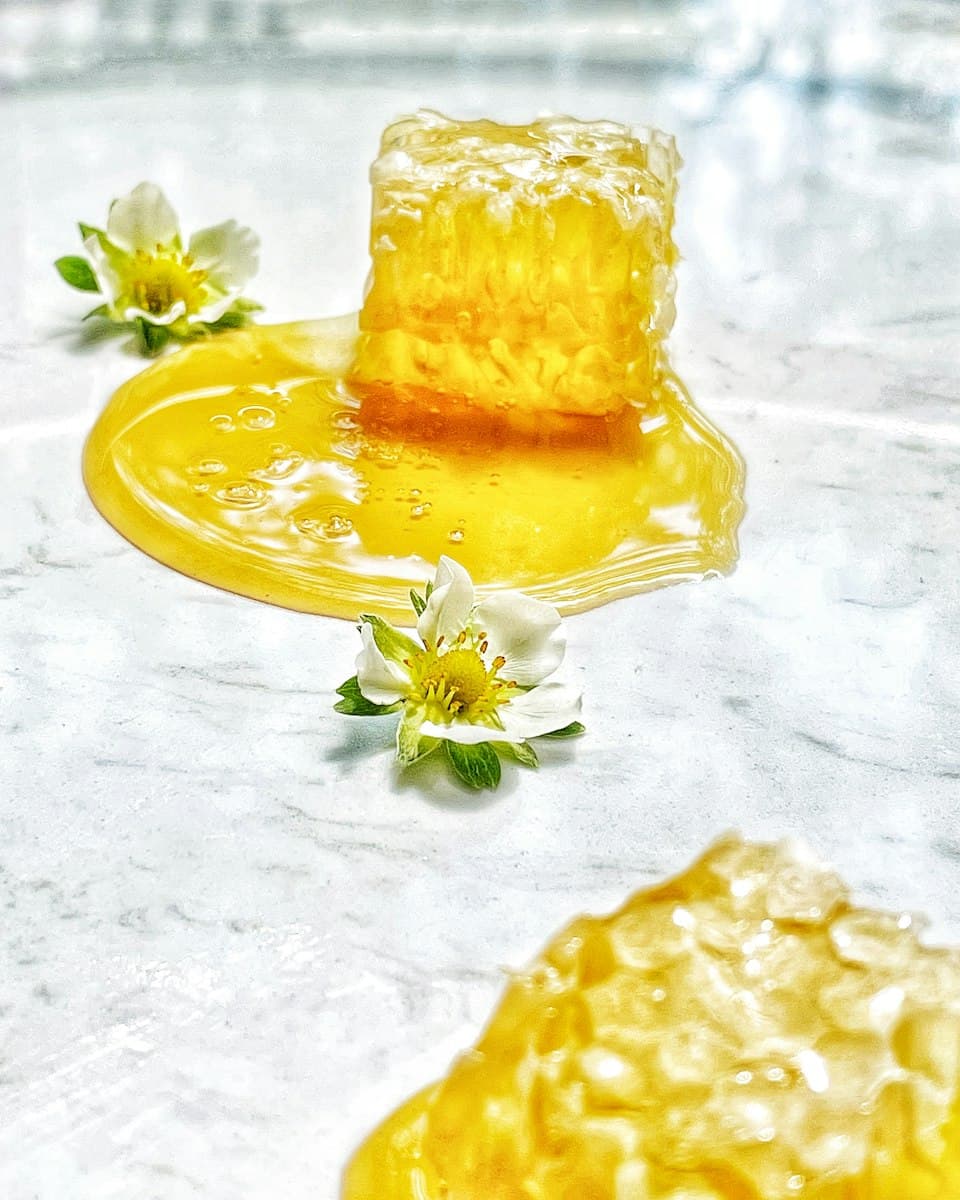
The viscous golden food of bees, used as a cosmetic ingredient across the entire history of the Mediterranean. Naturally antibacterial, mildly humectant, and gentler on skin than most surfactants - the reason it appears in our face creams, baby cleansers and lip products.

Mel

At a glance

Part used
Honey from Apis mellifera (the western honey bee)
Origin
Bekaa valley apiaries, Lebanon - mixed-flora forest honey
Process
Raw, cold-filtered to remove debris; not pasteurised (heat destroys enzymes)
pH
3.4 - 6.1 depending on floral source (mildly acidic)

Honey

Why bees make a cosmetic ingredient at all

Honey is composed of roughly 80% sugars, 17% water, and a small percentage of enzymes, organic acids, amino acids, vitamins and trace minerals. The bee's hypopharyngeal enzymes (mostly glucose oxidase) generate small amounts of hydrogen peroxide as the sugars break down, which is why honey is naturally antibacterial and why ancient Egyptian, Greek and Levantine medicine used it for wound dressings. As a cosmetic ingredient it acts as a humectant (draws moisture to skin), mild exfoliant (the natural acids), and gentle antibacterial.

Raw versus processed - the cosmetic difference

Most supermarket honey has been heated to 70 degrees C or higher to make it pourable and to delay crystallisation. That destroys the temperature-sensitive enzymes that give honey its cosmetic and medical properties. Cosmetic-grade honey is either raw (never heated above ~40 degrees C) or processed at low temperatures specifically to preserve enzyme activity. Our supplier is a Bekaa-valley apiary that cold-filters but does not pasteurise; you can taste this difference - the honey has a complex floral profile that supermarket equivalents lack.

Featured in

How Khan Al Saboun uses honey

Questions

Questions about honey in cosmetics

  • Is honey suitable for sensitive or eczema-prone skin?
    Often yes, and there is reasonable clinical literature on medical-grade Manuka honey applied to atopic dermatitis. Cosmetic honey at the concentrations used in finished products (typically 1-5%) is much gentler than what is used clinically. The exception: people with confirmed bee-product allergies (propolis, pollen) should avoid all honey-based cosmetics, including ours.
  • Will honey-based products feel sticky?
    No, when honey is properly emulsified into a cream or cleanser. The stickiness of pure honey comes from its sugar content reacting with water on contact with skin; in a finished cosmetic where honey is already dissolved into the water phase of an emulsion, that effect disappears. Our face creams and cleansers feel smooth, not tacky.
  • How long does honey-containing cosmetics last?
    Our finished products carry an 18-month opened shelf life thanks to the combined effect of honey's natural antibacterial activity and a small amount of phenoxyethanol or potassium sorbate as a secondary preservative. Pure raw honey itself never really spoils (archaeologists have eaten 3,000-year-old honey from Egyptian tombs), but once water is added in a cosmetic, microbial growth becomes possible.
  • Vegan options if honey is excluded?
    Honey-containing products account for a small minority of our line. If you avoid bee products on ethical grounds, our olive-oil soaps, body oils, frankincense-rose cleanser and most body splashes contain no honey, no beeswax and no propolis. Check the INCI list on the back of each product to be certain - we mark bee derivatives clearly.

Keep up to date with us

Sign up to receive 10% off your first order and stay up to date on new collections, events and exclusive offers.

You can unsubscribe at any time. See our privacy policy.